

add_to_cart or purchase.
The Events tab is where you analyze those actions. It has three sub-tabs:
- Events Funnel shows how many people make it through a sequence of steps, and where the rest give up.
- Events Log lists every single action as it arrived, so you can inspect one in detail.
- Your Events lists which action names your app is sending at all.
?p_id=YOUR_PROJECT_ID to the address for the project you have selected.
Everything on this tab comes from what your app reports. If an action is missing here, the gap is in your app’s
tracking code rather than in the dashboard. See Tracking Custom
Events and Revenue Tracking.
Events Funnel
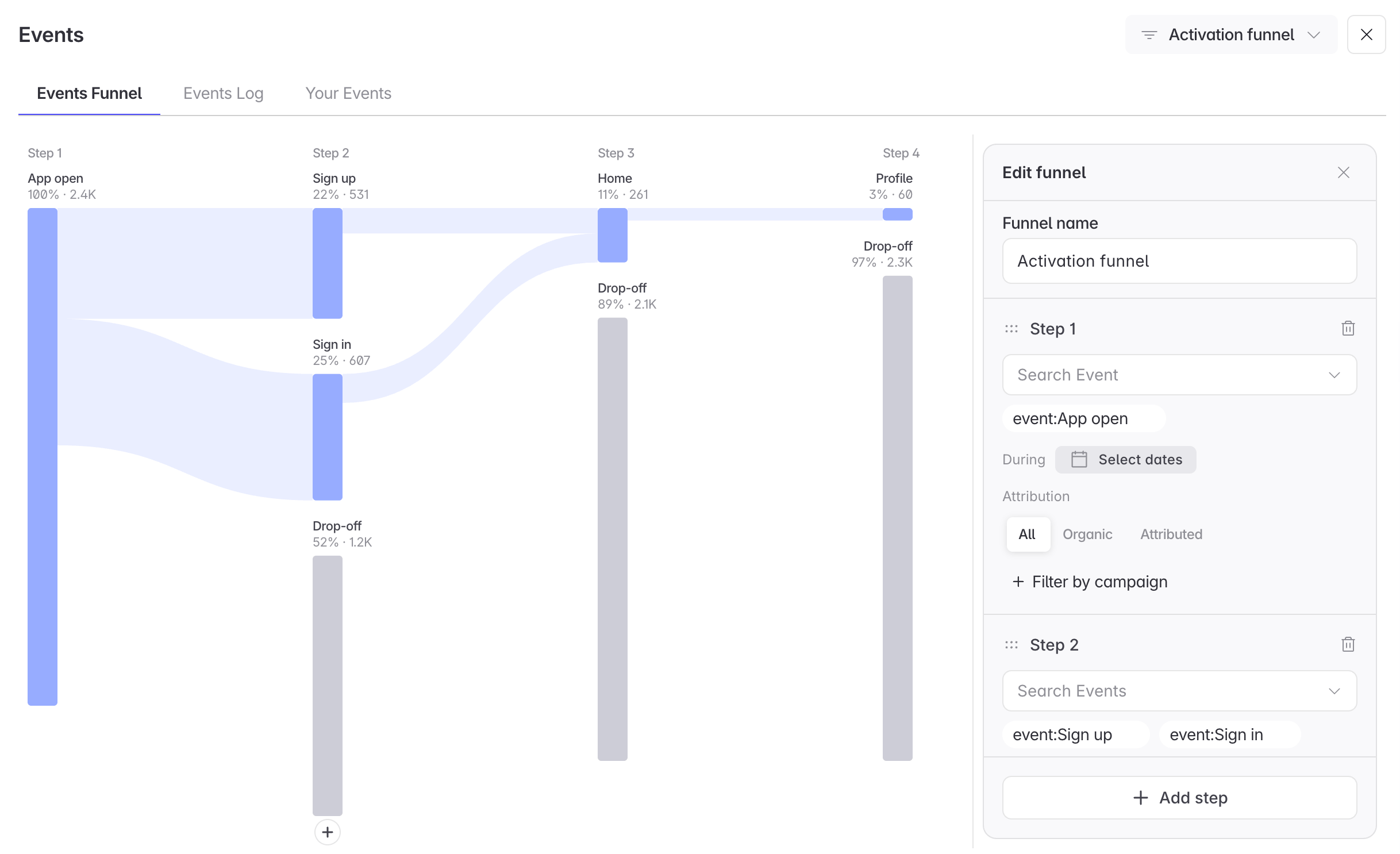
A funnel measures how many people get through a sequence of steps, and how many drop out along the way. For example: installed the app → signed up → made a purchase. Events Funnel is the sub-tab you land on first.Building a funnel
Open the editor with the pencil icon next to the funnel name.1
Define step 1
Step 1 sets your starting group, the people every later step is measured against. Pick it with Search
Event. Step 1 takes exactly one event.Three controls on step 1 apply to the whole funnel rather than only the first step. During sets the date
range, Attribution limits the funnel to All, Organic, or Attributed users, and Filter by
campaign narrows it to particular campaigns.
2
Add the steps that follow
Click Add step, then use Search Events to pick one or more. A step holding several events lets through
anyone who triggered any of them.Drag a step by its handle to reorder it, or use the delete icon to remove it.
3
Save the funnel
Enter a Funnel name. A funnel needs at least two steps before you can save it.
Reading the chart
Each step shows how many users reached it and what share of your starting group that represents. In the funnel above, 2.4K users opened the app. 531 of them signed up, which is 22% of that original 2.4K. By step 3 only 261 are left, which is 11% of the same 2.4K. Drop-off is counted the same way. It is everyone from the step 1 group who never reached that step, so it keeps growing as you move down the funnel rather than showing the loss from one step to the next. That is why drop-off reads 52% at step 2 and 89% at step 3. A step holding more than one event gets a band per event. Step 2 above splits into Sign up and Sign in, and anyone who did either one gets through. Any action your app reports can be a step, so a funnel can cover the whole path from install through to purchase.Managing saved funnels
- Switch between your saved funnels using the dropdown at the top.
- Change a step directly from the chart, or reopen the editor.
- Use Save as new to make a copy of a funnel and change the copy without losing the original.
Events Log
Events Log is the record of every action Linkrunner has received, newest first, shown a page at a time. Each row shows Event Name, Timestamp, Event Type, User, SDK Version, and Platform. The User column shows Unidentified when no user record is attached to the action, and Hashed when there is one but the personal details are held back. See Hashed and identified users. Filter by All Channels, All Events, platform, Select dates, and Users. There is also an All / Organic / Attributed toggle, which narrows the log to actions from users who arrived on their own versus users Linkrunner matched to an ad click.Inspecting a single event
Click a row to expand it and see everything recorded about that action.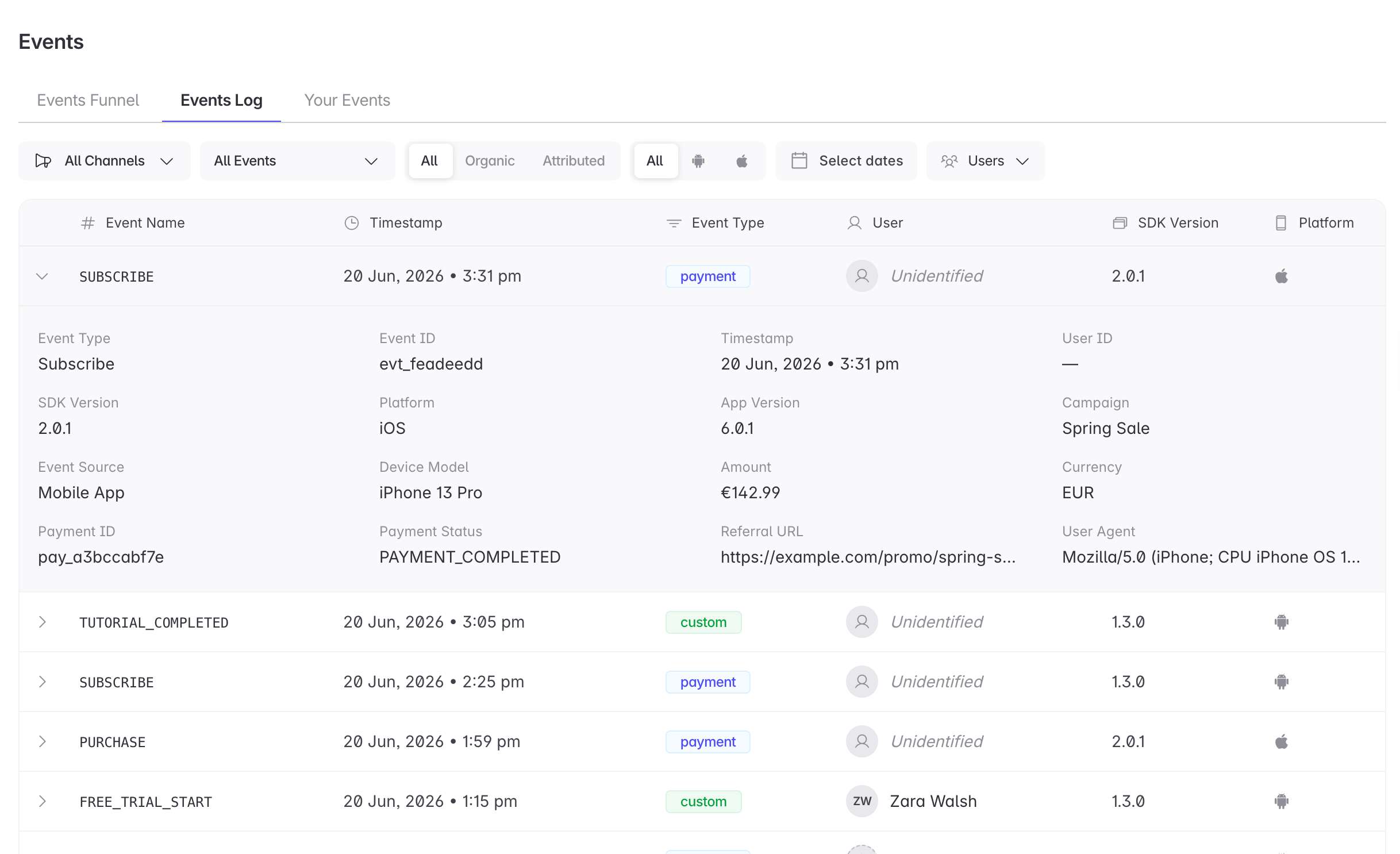
Payment events
Payments carry four extra fields: Amount, Currency, Payment ID, and Payment Status. These show the transaction exactly as Linkrunner received it, so check them first if your revenue numbers look wrong somewhere else.Your Events
Your Events lists the action names Linkrunner has received for this project. Each row shows the Event Name, its Event Type, and the Channels that have sent it. There are two ways to read it:- Down the event column: is everything your app is meant to be sending actually arriving? A name that is missing means the action is not being reported, not that the dashboard is behind.
- Across the channels column: which ad channels are driving which actions.
What to use this for
Find where people give up. A funnel from install to purchase tells you which single step loses the most users, so you can fix that step instead of reworking the whole flow. Check a release without asking for logs. After shipping, filter the Events Log to the action you care about and look at SDK Version on the newest rows. This replaces asking an engineer to pull logs for you. Confirm an action exists before you rely on it. Check Your Events for the name and its channels before you build a cohort, an ad audience, or a conversion around it. Look into a single payment. Filter to the user, expand the payment, and read the amount, currency, and status. Compare the same flow across campaigns. Set the campaign filter on step 1 and read the same funnel one campaign at a time.Troubleshooting
My event is not in the Events Log
My event is not in the Events Log
Linkrunner only keeps data for users it has attributed, meaning it has matched their install back to the click
or link that led to it. If the device never completed a click and install that Linkrunner could match, its
actions are not recorded. Check the flow with SDK Integration Testing.
I cannot save my funnel
I cannot save my funnel
A funnel needs at least two steps, and step 1 must have exactly one event. Add a second step, or cut step 1 down
to a single event.
An event shows in Your Events but my funnel returns no users
An event shows in Your Events but my funnel returns no users
Check the date range and campaign filters on step 1. They apply to the whole funnel, so a narrow window there
empties every step below it.
Payment fields are empty on a payment event
Payment fields are empty on a payment event
The amount, currency, and payment ID come from the
capturePayment call in your app. Confirm your app is
passing them. See Revenue Tracking.